
Hold Up…People Are Trying to Trademark Their VOICES Now?
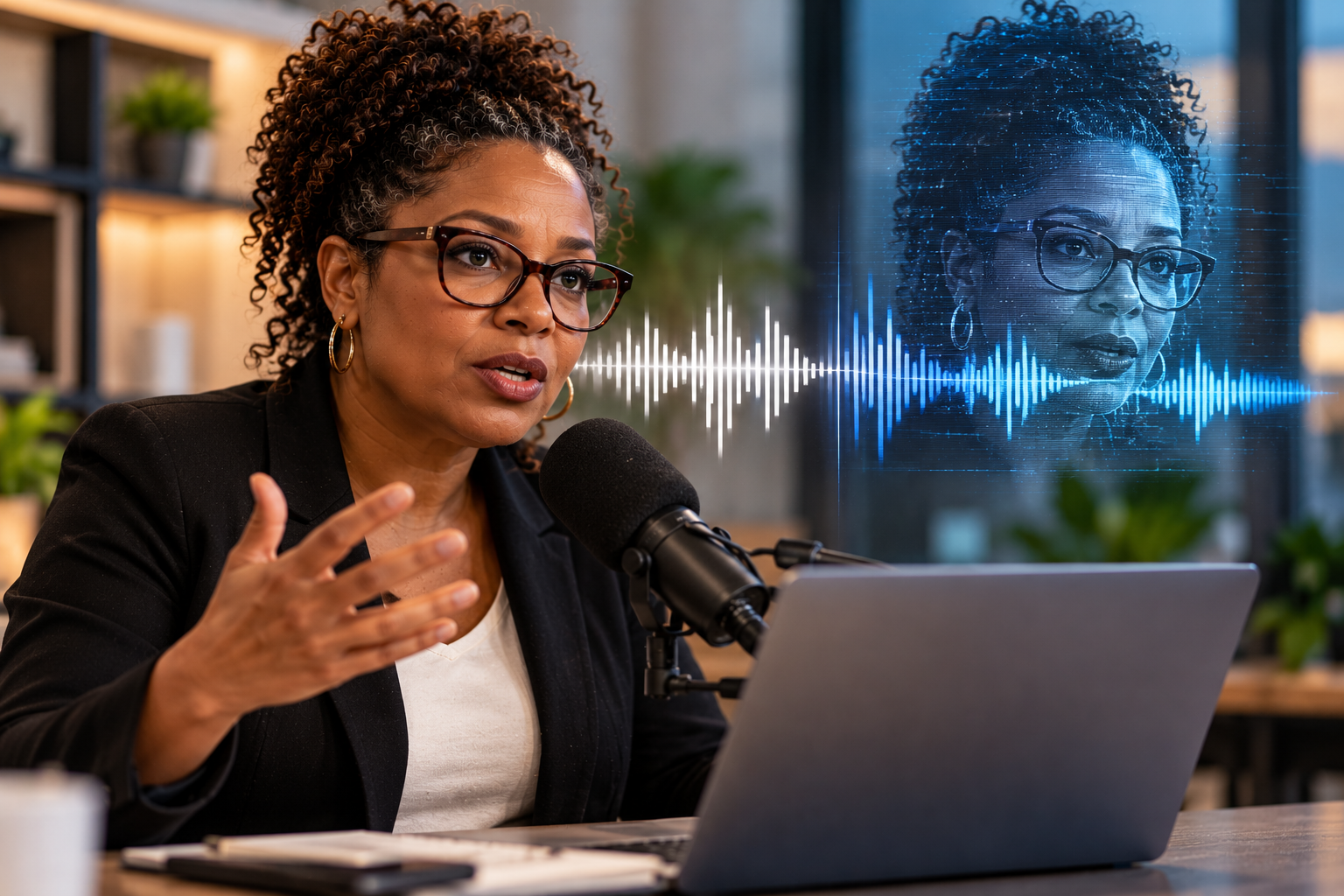
Well, this is one I didn’t have on my 2026 bingo card. Italian Prime Minister Giorgia Meloni has applied to trademark her voice. Yes, you read that correctly. We’re not talking about trademarking her name, a logo, or a political slogan. We’re talking about protecting the sound of her actual voice, and AI is a big reason why this conversation is happening.
Meloni filed the application with the European Union Intellectual Property Office on October 5. According to reporting on the filing, the application includes a short recording of Meloni saying in Italian, “I am Giorgia Meloni.” The application is still under review, so she doesn’t currently have an approved EU trademark on her voice.
Why Would Somebody Trademark Their Voice?
Because AI can now imitate voices remarkably well. Voice-cloning technology can analyze recordings of a person speaking and then generate entirely new audio that sounds like that person, even though the real person never said those words. When technology is used to create convincing fake audio, video, or images of real people, we generally hear them described as deepfakes.
A trademark wouldn’t put some magical lock around Meloni’s voice or make it technologically impossible for AI to imitate her. What it could potentially provide is another legal avenue for challenging certain unauthorized uses of her voice. Exactly how much protection that would provide remains an open question, particularly because the application hasn’t yet been approved.
This Is Becoming a Much Bigger Issue
Meloni isn’t the first public figure to face questions about AI copying someone’s identity. Taylor Swift was targeted with sexually explicit AI-generated images in 2024, and Scarlett Johansson raised concerns when an OpenAI chatbot voice sounded similar to hers after she had declined to provide her voice for the product. OpenAI said the voice was not an imitation of Johansson and later removed it.
There’s also a recent case out of Japan that makes this issue particularly interesting. A Tokyo court recognized legal protection for the voice of Japanese actor Kenjiro Tsuda after an account used an AI-generated voice resembling his to narrate more than 180 videos. The court found that the unauthorized commercial use violated his publicity rights.
These cases aren’t identical, and the laws involved aren’t identical either. But together they point toward a question we’re probably going to hear a lot more often as generative AI improves: How much of you actually belongs to you?
Okay, But What Does This Have to Do With Me?
Quite a bit, actually, because you don’t have to be a celebrity or a prime minister for someone to attempt to clone your voice. Regular people put recordings of themselves online every day through TikTok, Instagram, YouTube, podcasts, livestreams, video messages, and other platforms. As voice-cloning tools improve, that audio can potentially become useful material for someone trying to impersonate you.
Imagine getting a frantic call that sounds exactly like your daughter, grandson, spouse, or best friend. The person sounds scared and says something has happened and they need money immediately. Your natural reaction might be to respond to the familiar voice before you’ve had time to question whether you’re actually talking to the person you think you are.
That’s what makes AI-enabled impersonation different from the scam emails many of us learned to recognize years ago. Bad grammar or a strange email address might have tipped you off before. When the thing you’re being asked to distrust is the familiar sound of somebody you love, our old instincts for figuring out what’s real don’t work quite as well.
So…Who Owns Your Voice?
That’s where things get complicated. There isn’t one worldwide law that simply says nobody may clone another person’s voice with AI. Depending on where someone lives and what happened, protections may come from a mixture of privacy laws, publicity or personality rights, fraud and impersonation laws, intellectual-property rules, or newer laws specifically addressing AI-generated content.
That’s also what makes Meloni’s trademark application interesting beyond the fact that she’s a prime minister. It’s an example of someone trying to use an established legal system to address a problem created by technology that is developing much faster than many of the laws governing it. Whether trademark law ultimately becomes an important part of protecting people’s voices remains to be seen.
What Can Regular People Do?
For now, one of the simplest protections doesn’t require any fancy technology. If someone calls claiming to be a family member or friend and suddenly needs money, personal information, a password, or something else urgently, don’t rely on the voice alone. Hang up and contact that person through a phone number or method you already know belongs to them.
Families can also agree on a private verification question or phrase for emergencies. The point isn’t to become suspicious of every phone call or panic about AI. It’s simply to recognize that a familiar voice isn’t quite the proof of identity that it used to be.
And that’s the part of this story I think matters most for everyday people. For most of our lives, when we thought about protecting our identity, we thought about Social Security numbers, passwords, credit cards, signatures, and maybe fingerprints. AI is forcing us to think about our identity more broadly because our faces, voices, and other recognizable characteristics can now be reproduced in ways that weren’t realistically available to most people before.
So no, I’m not running out tomorrow morning trying to trademark my voice. 😂 But I am paying attention to what happens with cases like this, because the bigger question isn’t really whether a prime minister can trademark four seconds of audio. It’s how we’re going to protect all of us when technology can make something look and sound like us even when we had absolutely nothing to do with creating it.
And that is a conversation worth having.

